Struggling in a healthcare crisis? Click here now →









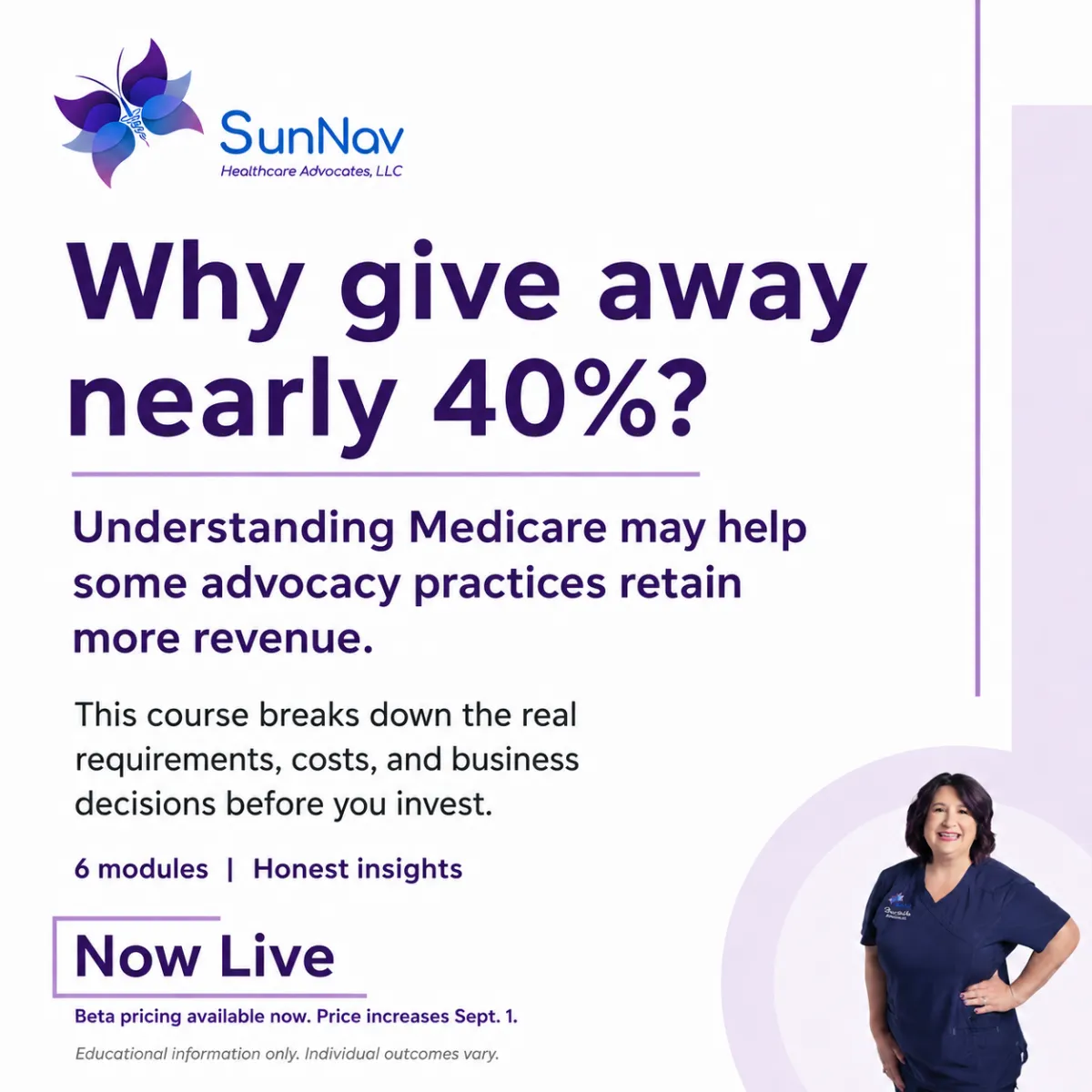
Stop Leaving Nearly 40% on the Table: Why It's Time to Understand Medicare
Stop Leaving Nearly 40% on the Table: Why It's Time to Understand Medicare
You didn't get into patient advocacy for the paperwork. You got into it because you're good at fighting for people who don't know how to fight for themselves inside a system that wasn't built to make sense.
But here's an uncomfortable truth: a lot of independent patient advocacy practices are quietly giving away nearly 40% of the revenue they could be retaining — not because they're bad at their jobs, but because nobody ever laid out the real picture of how Medicare fits into an advocacy practice, what it actually costs to understand it, and what the honest tradeoffs are.
That gap doesn't close itself. And every month it stays open is a month of unnecessary margin loss on work you're already doing.
You've Probably Felt This Already
Be honest with yourself for a second. Have you ever:
Gotten a Medicare-related billing question from a client and felt less confident answering it than you wanted to be?
Wondered whether there was a better way to structure your independent advocacy practice around Medicare work, but never had the time to figure out what that actually meant?
Watched a chunk of your potential revenue disappear into a third-party billing arrangement and told yourself you'd look into alternatives "eventually"?
Searched for "how do patient advocates get paid for Medicare work" or "Medicare billing for independent advocates" and come up with scattered forum posts instead of a real answer?
Wondered whether becoming Medicare-ready is even worth it for a practice your size?
If any of that sounds familiar, you're not behind. You're just missing the piece almost nobody hands advocates directly: a clear, honest, foundational understanding of how Medicare actually fits into this work — the landscape, the real costs, and the tradeoffs that matter for a practice like yours.

Why This Gap Exists in the First Place
Medicare billing education for advocates simply hasn't existed in a coherent form. Nursing programs don't cover it. BCPA certification touches the edges of it but wasn't built to walk you through the business side of it. And most of what's searchable online is either written for physicians and billing specialists — dense, clinical, and irrelevant to how an independent advocacy practice actually runs — or it's so vague it doesn't help you make an actual decision.
The result: advocates either avoid this part of their business entirely, hand the whole problem to a third-party billing company and accept whatever cut that costs them, or try to piece together an understanding from fragments — a webinar here, a Facebook group thread there — without ever getting the full, honest picture in one place.
That patchwork approach is exactly what leads to leaving money on the table. Not because advocates aren't capable of understanding this. Because nobody built the resource that assumes they're capable and treats them like the professionals they are.
This Is Not Another Vague "Medicare 101"
Terry McLellan, BSN, RN, BCPA, didn't build SunNav Equip Foundations from a textbook. She built it from the inside — figuring out, case by case and mistake by mistake, what it actually takes to make an independent advocacy practice Medicare-ready.
She kept getting asked the same question by other advocates: how did you actually do this?
So she built the answer. Six modules. No filler. No theory disconnected from the real world of running a practice. Just the foundational education advocates keep saying they wish someone had handed them before they started guessing.
This isn't generic "understanding Medicare as a patient" content repackaged for advocates. It's built specifically around the questions independent advocates and advocacy practice owners actually ask when they're trying to figure out whether — and how — Medicare-related work fits into what they're already doing.
What You Walk Away With
By the end of SunNav Equip Foundations, you'll have:
A working understanding of the Medicare landscape from an advocate's — not a patient's — point of view, including the practical distinction between Original Medicare and Medicare Advantage and why it matters for how you'd structure this work
A plain-language grasp of the key operational steps involved, so you're not starting from zero if you decide to move forward
An honest accounting of the costs and hurdles most advocates don't see coming until it's too late to plan around them
A real framework for deciding whether this path fits your specific practice — because it doesn't fit everyone, and pretending otherwise wouldn't serve you
A clearer sense of where independent advocacy practices tend to leave revenue on the table, and why
This is decision-making clarity. Not a hard sell into a path that isn't right for your caseload. The advocates who benefit most from this course are the ones ready to stop guessing and start deciding with real information — whether that's advocates just starting to explore Medicare-related services, or established practice owners who've been putting off understanding this for years.
"But Is This Actually Worth It for My Practice?"
Fair question. Here's the honest answer: it depends on your practice. If most of your caseload is Medicare Advantage clients, the calculus looks different than it does for a practice built around Original Medicare cases. If you're doing this work part-time, the math changes again. If you're a solo advocate versus running a small team, the considerations shift once more.
That's exactly why this course exists — not to talk you into something, but to give you the information to make that call yourself, instead of guessing or, worse, staying stuck in an arrangement that's quietly costing you money every month.
Some of the questions this course helps you answer for your own situation:
Does it make sense for an independent patient advocate to pursue Medicare-related billing knowledge at all, given my current caseload?
What's the realistic cost — in time, effort, and money — of becoming more Medicare-ready as a practice?
Where do most advocacy practices actually lose revenue when Medicare clients are involved, and does that apply to me?
Is my practice better suited to Original Medicare clients, Medicare Advantage clients, or a mix — and what does that mean for how I should think about this?
What would I need to understand before even considering a bigger structural change to how my practice handles Medicare-related work?
The Cost of Waiting
Every month you don't understand this landscape is a month where the status quo keeps winning by default — not because it's the better option, but because it's the familiar one.
Advocates who keep pushing this off tend to fall into one of three patterns: staying entirely private-pay and never exploring whether Medicare-related work could add a sustainable revenue stream, staying in a third-party billing arrangement that takes a significant cut without ever evaluating alternatives, or trying to figure it all out reactively — after a client situation forces the question — instead of proactively, on their own timeline.
None of those are wrong choices, necessarily. But none of them are informed choices either, and that's the actual problem this course solves.
Who This Is Built For
Independent patient advocates curious whether Medicare-related work belongs in their practice
Advocacy practice owners evaluating this as a potential new service line
Professionals actively working toward building Medicare-ready services who want a foundational, honest starting point
Who this isn't for: Medicare beneficiaries looking for help understanding their own personal coverage. This is built for advocates and practice owners evaluating their business — not individuals seeking personal Medicare guidance.

Frequently Asked Questions
Do I need to be an RN or BCPA to take this course? No specific credential is required to enroll. The course is built for independent patient advocates and practice owners broadly, though how the material applies to your work may vary somewhat by credential and scope of practice.
Is this course only relevant if most of my clients have Original Medicare? No — the course covers the practical differences between Original Medicare and Medicare Advantage specifically so you can evaluate what's realistic for your particular client mix, whichever way that mix leans.
How long does it take to complete? The course is self-paced across six modules, built to be worked through at whatever speed fits your schedule.
Will this course tell me exactly how to bill Medicare directly? This is foundational, decision-oriented education — it's built to help you understand the landscape and evaluate whether pursuing this further makes sense for your practice, not to serve as a step-by-step implementation manual.
What if I decide, after taking the course, that this isn't right for my practice? That's a legitimate outcome. The course is built to help you make an informed decision either way — moving forward or deciding this isn't the right fit right now. Both are useful conclusions.
The Real Question
You already do the hard part — the advocacy itself. The only question left is whether you're going to keep guessing about how Medicare fits into that work, or finally get the straight answer.
Beta enrollment is open now. Public price goes up in September. The advocates who move now are the ones shaping — and benefiting from — this course first.
To learn more go to: https://bit.ly/SunNavEquipFoundations
Educational information only. Individual outcomes vary based on your practice, market, and caseload.


Disclaimer: We do not provide legal or financial advice. For such matters, please consult with a licensed professional. Referrals are available upon request but do not constitute an endorsement.
Note: We have been approved to bill Traditional Medicare as of 6/16/2025